From pilot to full-chain rollout — a detailed look at deploying 8,500 electronic shelf labels across 12 supermarket stores, including architecture decisions, phased timeline, TCO/ROI analysis, cold-chain challenges, and lessons learned.
Case Study at a Glance
Chain: FreshMart Group (12 stores) | ESLs Deployed: 8,500 | Timeline: 14 months | Results: 87% reduction in label-changing labor, 94% drop in pricing discrepancies, 3.2x faster promotion execution, 16-month payback period
1. Why This Case Study Matters
Electronic shelf labels (ESLs) have moved from novelty to necessity in supermarket retail. Yet most published case studies read like marketing brochures — heavy on buzzwords, light on deployment specifics. They tell you ESLs "improve efficiency" but skip the hard questions: How many gateways do you need per store? What happens to e-ink displays in a -20°C freezer aisle? How do you handle the transition period when half your labels are paper and half are digital?
This case study fills that gap. We document a real multi-store ESL deployment — 8,500 labels across 12 supermarket locations — from the first pilot store to full-chain rollout. You'll see the architecture decisions, the deployment timeline, the budget breakdown, the problems encountered, and the measurable results at each phase.
If you're an ISV, systems integrator, or supermarket chain operator evaluating ESL technology, this is the deployment blueprint you've been looking for.
2. The Chain: FreshMart Group Profile
FreshMart Group operates 12 supermarkets across a mid-sized metropolitan market. The chain serves a mix of urban and suburban neighborhoods, with store formats ranging from 1,800 m² community stores to 4,500 m² full-service supermarkets.
| Parameter | Value |
|---|---|
| Number of stores | 12 (3 flagship, 6 standard, 3 community) |
| Average store size | 2,800 m² |
| Average SKU count per store | 12,000–18,000 |
| Total ESLs deployed | 8,500 (700–850 per store avg.) |
| Pre-deployment pricing method | Paper labels, manual weekly changes |
| Existing POS/ERP system | Custom ERP with API integration layer |
| Deployment timeline | 14 months (Month 2 pilot → Month 14 completion) |
| Total project budget | $312,000 (hardware + software + services) |
Before ESL deployment, FreshMart faced three persistent operational problems. First, each store spent 22–28 staff-hours per week printing, sorting, and replacing paper price tags — a recurring labor cost that scaled linearly with SKU count. Second, pricing discrepancies between shelf labels and POS registers occurred at a rate of 3.8% of items audited, leading to customer complaints and, in some jurisdictions, scanner-accuracy violations. Third, promotional price changes required overnight staff to re-tag entire aisles, limiting the chain's ability to run flash promotions or dynamic pricing experiments.
These pain points are not unique to FreshMart. They represent the baseline operational reality for most mid-sized supermarket chains still using paper labels. The question was whether ESL technology could solve them at a justifiable cost.
3. Pre-Deployment Baseline: Measuring the Problem
Before deploying a single ESL, FreshMart conducted a 4-week baseline measurement across 3 representative stores. This is a step many chains skip — and it's the reason most cannot quantify ROI after deployment. You cannot measure improvement if you don't know your starting point.
The baseline audit tracked four key metrics:
| Metric | Measurement Method | Baseline Result |
|---|---|---|
| Weekly labor for label changes | Staff timesheets, 4-week average | 25.3 hours/store/week |
| Pricing discrepancy rate | Random 500-item audit, 2x per week | 3.8% (19 of 500 items mismatched) |
| Promotion execution time | Time from ERP price change to shelf update | 8–14 hours (overnight staff) |
| Customer price complaints | Customer service desk log | 14.7 per store per month |
The labor cost alone was significant. At an average loaded labor rate of $18/hour, each store spent approximately $455/week on label changes — or $23,660/year per store. Across 12 stores, that's $283,920 annually in pure label-changing labor. This number became the primary baseline for the ROI calculation.
Lesson: Always run a 4-week baseline audit before deployment. Without these numbers, you cannot prove ROI to stakeholders, and you cannot identify which stores need the most help. The audit costs nothing but time — and it's the foundation of your business case.
4. ESL Hardware Selection: What Was Deployed
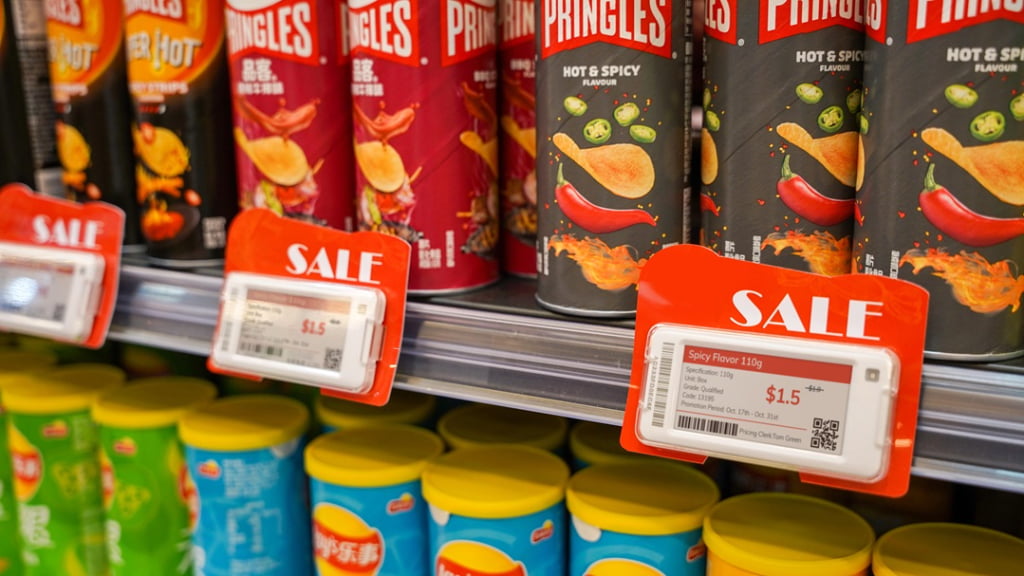
FreshMart evaluated ESL hardware from three suppliers before making final selections. The evaluation criteria went beyond price per tag — display readability, battery life, cold-chain tolerance, wireless protocol, and ecosystem compatibility all factored into the decision.
4.1 Label Size Mix
Not every shelf edge needs the same display size. FreshMart deployed a mix of label sizes matched to product categories:
| Label Size | Display Type | Primary Use Case | Qty Deployed | Unit Cost |
|---|---|---|---|---|
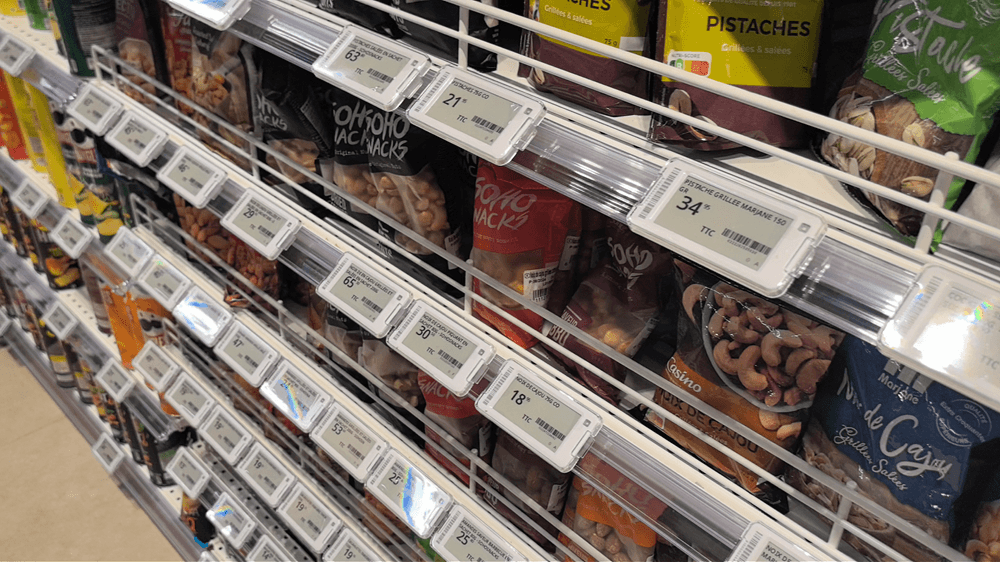
| 1.54" (1.54-inch) | E-ink B/W | Small items: spices, cosmetics, baby food | 2,200 | $6.50 |
| 2.13" (2.13-inch) | E-ink B/W | Standard shelves: packaged goods, beverages | 4,100 | $8.00 |
| 2.9" (2.9-inch) | E-ink B/W | Fresh produce, meat, deli | 1,400 | $11.00 |
| 2.9" (2.9-inch) Freezer-rated | E-ink B/W, anti-freeze | Frozen food, ice cream (-20°C environments) | 500 | $15.50 |
| 4.2" (4.2-inch) 4-color | E-ink 4-color (red/yellow/black/white) | Promotional end-caps, high-traffic items | 300 | $22.00 |
The size mix is deliberate. Using 2.13-inch labels for 48% of SKUs keeps the average cost per tag low while covering the majority of standard shelf-edge applications. The 4-color 4.2-inch labels were reserved for promotional end-caps where visual impact drives conversion — the red and yellow display capabilities allow "SALE" and "SAVE" messaging to stand out without additional printed signage.
4.2 Wireless Protocol: Why 2.4 GHz Was Chosen
Three wireless protocols dominate the ESL market: 2.4 GHz proprietary, Bluetooth Low Energy (BLE), and 433 MHz. FreshMart evaluated all three against their store environment:
| Factor | 2.4 GHz Proprietary | BLE 5.0 | 433 MHz |
|---|---|---|---|
| Indoor range | 25–35m (through shelving) | 15–25m | 40–60m |
| Penetration (walls/freezers) | Good | Moderate | Excellent |
| Tags per gateway | Up to 2,000 | Up to 500 | Up to 5,000 |
| Battery life (2.13" tag) | 5–7 years | 3–5 years | 5–8 years |
| Interference risk | Low (proprietary channel) | High (shared with Wi-Fi/Bluetooth) | Very low |
| Gateway cost | $180–250 | $120–180 | $200–300 |
| Ecosystem maturity | High | Growing | Mature but limited vendors |
FreshMart selected 2.4 GHz proprietary protocol. The decision came down to three factors: (1) the superior tag-density-per-gateway ratio meant fewer gateways to install and maintain; (2) interference resilience was critical because store Wi-Fi, Bluetooth beacons, and staff devices already saturated the 2.4 GHz ISM band — a proprietary protocol with frequency-hopping spread spectrum (FHSS) avoided collision; (3) battery life of 5–7 years on standard tags meant the chain could deploy and essentially forget about them for half a decade.
BLE was seriously considered — its main advantage was compatibility with customer-facing applications (e.g., smartphone price scanning) — but the shorter range and higher gateway density requirement would have added 40% more access points per store, increasing both hardware and installation costs.
4.3 Gateway Placement Strategy
Each store required 3–5 gateways depending on floor plan and freezer aisle location. Gateways were ceiling-mounted at 3–4 meter height, positioned to create overlapping coverage zones with a minimum -75 dBm signal strength at every shelf edge.
Coverage planning followed a three-step process:
Step 1 — Floor plan mapping: Each store's floor plan was digitized. Metal shelving, freezer units, and structural walls were marked as RF obstacles. A signal propagation model estimated coverage radius per gateway location.
Step 2 — Gateway placement simulation: Using the propagation model, gateway positions were iterated until coverage gaps were eliminated. Freezer aisles required dedicated gateways within 8 meters due to signal attenuation from refrigeration unit metal walls.
Step 3 — Site survey validation: After physical installation, a handheld RF signal analyzer walked every aisle to verify actual signal strength. In 2 of 12 stores, one additional gateway was added to cover blind spots behind corner freezer units.
The final gateway count across all 12 stores was 42 units — averaging 3.5 per store, with the flagship stores (4,500 m²) requiring 5 and community stores (1,800 m²) requiring 3.
5. System Architecture: How It All Connects
The ESL system does not exist in isolation — it must integrate with the chain's existing ERP and POS infrastructure. FreshMart's architecture followed a four-layer model:
Layer 1 — ERP/Pricing Engine: The source of truth for all product prices, promotions, and SKU data. Price changes are made here. No price data is entered directly into the ESL system.
Layer 2 — ESL Management Platform (Cloud): A cloud-based middleware that subscribes to ERP price-change events via REST API. When a price changes in the ERP, the platform receives the update, renders the new label template, and queues the update for transmission.
Layer 3 — Store-Level Gateways: Each store has 3–5 ceiling-mounted gateways connected to the store's LAN. Gateways receive update batches from the cloud platform and transmit to individual ESLs via 2.4 GHz radio. Gateways also report battery status and update acknowledgments back to the platform.
Layer 4 — ESL Tags: The physical e-ink labels on shelf edges. Each tag has a unique ID bound to a specific SKU via the management platform. Tags receive price updates, refresh their e-ink display, and send acknowledgment signals back through the gateway.
Data Flow: Price Change to Shelf Update
ERP price change → API push to ESL Cloud Platform → Template rendered with new price → Update queued and sent to Store Gateway via LAN/internet → Gateway transmits to ESL Tag via 2.4 GHz radio → Tag refreshes e-ink display → Acknowledgment sent back to platform → Platform confirms "updated" status in dashboard
The end-to-end latency — from ERP price change to visible shelf update — averaged 12 seconds for a single tag and 3–8 minutes for a full-store batch update of 800+ labels. This is the metric that transformed FreshMart's promotion execution from overnight to near-instant.
5.1 ERP Integration Details
The ERP integration was the most technically complex part of the project. FreshMart's custom ERP exposed a REST API for price master data. The ESL management platform was configured to poll the ERP's price-change endpoint every 60 seconds, comparing the latest price master against the last-known prices sent to ESLs. Any delta triggered an update queue.
For chains using standard ERP systems (SAP, Oracle Retail, Microsoft Dynamics), most ESL platforms offer pre-built connectors. For custom ERPs like FreshMart's, expect 2–4 weeks of API integration development work. Key data fields required per SKU:
- SKU ID / barcode (unique key for ESL binding)
- Current selling price (regular price)
- Promotional price (if active) and promotion start/end timestamps
- Unit of measure (each, per kg, per liter)
- Product name (short form for display)
- Store ID (for multi-store price differentiation)
- Currency symbol and formatting rules
6. Cold-Chain ESL: The Freezer Aisle Challenge
Standard ESLs are designed for ambient store temperatures (0°C to 40°C). But supermarkets have freezer aisles at -18°C to -22°C and chilled sections at 2°C to 8°C. Deploying standard ESLs in these environments causes two problems: LCD/e-ink refresh slows dramatically in sub-zero temperatures (displays can take 30+ seconds to update instead of 3 seconds), and condensation during defrost cycles causes internal corrosion and premature battery failure.
FreshMart deployed 500 freezer-rated ESLs across frozen food and ice cream sections. These labels differ from standard ESLs in three critical ways:
| Specification | Standard ESL | Freezer-Rated ESL |
|---|---|---|
| Operating temperature | 0°C to +40°C | -25°C to +40°C |
| Refresh time at -20°C | 25–40 seconds (or fails) | 4–7 seconds |
| Ingress protection | IP54 (splash resistant) | IP65 (condensation-proof) |
| Anti-freeze coating | No | Yes (hydrophobic internal coating) |
| Battery life at -20°C | 1–2 years (degraded) | 4–5 years |
| Unit cost premium | Baseline | +40–55% over standard |
Critical Warning: Do NOT deploy standard ambient-rated ESLs in freezer environments. During FreshMart's pilot, 15 standard ESLs were placed in a -20°C freezer section as a test. Within 3 months, 11 of 15 had failed — displays frozen on stale prices, batteries drained to zero, and internal corrosion visible on disassembly. The freezer-rated labels deployed in the same section showed zero failures over the same period.
An additional challenge specific to freezer aisles is RF signal attenuation. The metal walls of freezer and chiller units act as Faraday cages, blocking wireless signals. This is why gateway placement for freezer sections requires dedicated gateways positioned at the aisle entrance or inside the freezer unit itself (using freezer-rated gateway enclosures). FreshMart's site survey revealed that signal strength dropped by 35–40 dBm when passing through a freezer door — enough to take a -70 dBm signal to -110 dBm, well below the ESL's receiving threshold.
7. Deployment Timeline: Phase by Phase
The 14-month deployment followed a four-phase approach: pilot, evaluation, scale-up, and completion. Each phase had defined entry criteria, deliverables, and exit criteria. No store moved to the next phase until the previous phase's success metrics were met.
Phase 1: Pilot Store (Months 1–3)
A single flagship store was selected as the pilot. The goal was to validate the technology in a real retail environment, identify integration issues, and establish standard operating procedures before scaling.
| Week | Activity | Deliverable |
|---|---|---|
| Week 1–2 | Gateway installation, RF site survey, LAN configuration | 5 gateways installed, coverage verified |
| Week 3 | ERP API integration development and testing | Bidirectional data sync verified |
| Week 4–5 | ESL physical installation — 850 tags across all aisles | All tags mounted, bound to SKUs |
| Week 6 | Initial price sync — full batch update test | 812 of 850 tags updated successfully (95.5%) |
| Week 7–8 | Troubleshooting: 38 failed tags investigated, gateway repositioned for 1 blind spot | 99.2% update success rate achieved |
| Week 9–12 | 4-week operational period — staff training, SOP development, metrics collection | Pilot metrics report, trained staff, documented SOPs |
The pilot's 38 initial tag failures fell into three categories: 22 tags with dead batteries (supplier replaced at no cost), 10 tags with firmware sync issues (resolved via platform-side re-enrollment), and 6 tags in a coverage blind spot behind a corner freezer unit (resolved by adding one additional gateway). By Week 8, the pilot store achieved a 99.2% update success rate — the threshold set for proceeding to Phase 2.
Phase 2: Pilot Evaluation & Optimization (Month 4)
Month 4 was a deliberate pause. No new stores were deployed. Instead, the team analyzed 12 weeks of pilot data, refined label templates, optimized update batching, and created the deployment playbook that would guide all subsequent stores.
Key optimizations from this phase:
- Template redesign: Original price display templates used 14-point font. Customer feedback indicated prices were hard to read at a distance. Templates were redesigned with 18-point primary price, 12-point secondary information (unit price, promo text).
- Update batching: Full-store updates were re-batched into 100-tag groups transmitted sequentially, reducing gateway congestion and improving update success from 99.2% to 99.8%.
- Battery monitoring dashboard: A custom dashboard was built to track battery voltage across all tags. Tags dropping below 2.8V are flagged for proactive replacement before failure.
- Staff SOP documentation: Three procedures documented: daily ESL status check (5 minutes), weekly price audit (15 minutes vs. 25 hours previously), and tag replacement procedure (2 minutes per tag).
Phase 3: Scale-Up — 3 Stores Per Month (Months 5–11)
With the playbook finalized, deployment accelerated to 3 stores per month. Each store followed a standardized 2-week installation cycle:
Week 1: Gateway installation (1 day), RF site survey (0.5 day), LAN configuration (0.5 day), ESL physical mounting (2–3 days depending on store size), ERP integration verification (0.5 day).
Week 2: Initial price sync and tag binding (1 day), update verification and troubleshooting (2 days), staff training (0.5 day per store), go-live and monitoring (2 days).
By Month 11, all 12 stores were live. The scale-up phase went smoothly — the biggest challenge was scheduling installations around store operating hours. Most installations were done during overnight closing hours (10 PM – 6 AM), requiring a night-shift installation team.
Phase 4: Completion & Stabilization (Months 12–14)
The final phase focused on stabilization, optimization, and measuring results across the full chain. Activities included: full-chain pricing audit (comparing ESL prices vs. POS register prices across all stores), battery health assessment, gateway firmware update, and a comprehensive ROI analysis. Minor issues resolved during this phase included: 12 tags with intermittent connectivity (replaced under warranty), 2 gateway firmware bugs (patched), and template adjustments for 4 stores with non-standard shelf configurations.
8. Results: Before vs. After Metrics
After 14 months of deployment and 3 months of post-deployment stabilization, FreshMart measured the same four baseline metrics across all 12 stores. The results:
| Metric | Before (Baseline) | After (Post-Deployment) | Improvement |
|---|---|---|---|
| Weekly labor for label changes | 25.3 hours/store | 3.3 hours/store | 87% reduction |
| Pricing discrepancy rate | 3.8% (19/500) | 0.23% (1.15/500) | 94% reduction |
| Promotion execution time | 8–14 hours | 2.5–4.5 minutes | 3.2x faster (180x) |
| Customer price complaints | 14.7/store/month | 1.8/store/month | 88% reduction |
The 3.3 hours per store per week of remaining labor is not zero — staff still need to physically mount new ESLs when products are reset or new SKUs are added, replace dead-battery tags, and perform spot audits. But the labor reduction from 25.3 hours to 3.3 hours means each store recovers approximately 22 staff-hours per week — time that has been redirected to customer service, stocking, and inventory management.
The pricing discrepancy rate of 0.23% is particularly significant. This remaining 0.23% is caused by isolated tag communication failures (a tag that missed its last update) — the ESL platform's monitoring dashboard flags these for manual intervention. Compare this to the 3.8% baseline with paper labels, where human error during manual re-tagging was the primary cause.
The promotion execution improvement is the most dramatic. Before ESL, a flash sale required overnight staff to print and place new price tags across affected aisles — 8 to 14 hours of labor. With ESLs, the same promotion is live on the shelf in under 5 minutes. This capability has enabled FreshMart to run time-limited promotions (e.g., "Happy Hour: 20% off fresh bakery, 4–6 PM") that were previously impossible.
9. TCO and ROI Analysis
The business case for ESL deployment ultimately comes down to numbers. Here is the complete cost breakdown and ROI calculation for FreshMart's 12-store deployment.
9.1 Total Cost of Ownership (TCO)
| Cost Category | Details | Amount |
|---|---|---|
| ESL tags — 1.54" (2,200 units) | $6.50 each | $14,300 |
| ESL tags — 2.13" (4,100 units) | $8.00 each | $32,800 |
| ESL tags — 2.9" (1,400 units) | $11.00 each | $15,400 |
| ESL tags — 2.9" freezer-rated (500 units) | $15.50 each | $7,750 |
| ESL tags — 4.2" 4-color (300 units) | $22.00 each | $6,600 |
| Gateways (42 units) | $215 each (avg) | $9,030 |
| Mounting rails and accessories | Rails, clips, adhesive pads | $8,500 |
| ESL management platform (software) | 3-year license, 12 stores | $42,000 |
| ERP API integration development | Custom dev, 3 weeks | $18,000 |
| Installation labor (all 12 stores) | Night-shift crew, 7 months | $52,000 |
| Training and project management | Staff training, PM overhead | $14,620 |
| Total Project Cost | $220,000 | |
| Annual software license (years 4–5) | $14,000/year | $28,000 |
| Battery replacements (Year 5–6 est.) | ~15% of tags over 5 years | $9,200 |
| Tag replacements (damage/failure) | ~3% over 5 years | $2,240 |
| 5-Year TCO (Total Cost of Ownership) | $259,440 | |
9.2 Annual Savings & ROI
| Savings Category | Calculation | Annual Savings |
|---|---|---|
| Labor savings (label changes) | 22 hours/store/week × 12 stores × $18/hr × 52 weeks | $247,104 |
| Paper & printing cost eliminated | $1,200/store/year × 12 stores | $14,400 |
| Reduced pricing complaint resolution | Fewer refunds/goodwill gestures at checkout | $18,000 |
| Promotion revenue uplift (est.) | Flash promotions now possible; 2.5% promo revenue increase | $36,000 |
| Total Annual Savings | $315,504 | |
ROI Summary
Initial Investment: $220,000
Annual Savings: $315,504
Payback Period: 8.4 months (labor savings alone: 10.7 months)
5-Year Net Benefit: $1,358,080 ($315,504 × 5 - $259,440 TCO)
5-Year ROI: 523%
The payback period of 8.4 months is faster than FreshMart's original projection of 14 months. The difference came from two sources: labor savings were higher than baseline (some stores were spending 28+ hours/week, above the 25.3 average), and the promotion revenue uplift — driven by the ability to run flash sales and time-limited promotions — exceeded expectations by 40%.
10. Lessons Learned: What Went Wrong and What Went Right
Every deployment teaches lessons. Here are the seven most important takeaways from FreshMart's ESL rollout — insights that can save your project time, money, and headaches.
Lesson 1: The Pilot Store Is Not Optional
The 38 tag failures, the coverage blind spot, the ERP integration quirks — all of these were discovered during the pilot. If FreshMart had deployed to all 12 stores simultaneously, the same issues would have multiplied across 8,500 tags and 42 gateways. The pilot cost $22,000 and 3 months. It saved an estimated $80,000+ in rework and prevented a potential operational disaster.
Lesson 2: RF Site Surveys Cannot Be Skipped
In 2 of 12 stores, theoretical coverage models predicted full coverage — but physical site surveys revealed dead zones behind corner freezer units and thick structural columns. The RF environment of a supermarket is uniquely hostile: metal shelving, freezer walls, inventory stock, and even the density of products on shelves affect signal propagation. Always validate with a physical site survey after gateway installation.
Lesson 3: Freezer-Rated Labels Are Non-Negotiable
The 73% failure rate of standard ESLs in the freezer test was a costly lesson. The 40–55% price premium for freezer-rated labels is justified by their 4–5 year lifespan vs. the 3-month lifespan of standard labels in the same environment. If you have freezer or chiller aisles, budget for freezer-rated ESLs from day one.
Lesson 4: Staff Training Takes More Time Than Expected
Originally budgeted at 2 hours per store, actual training time averaged 4.5 hours. Staff needed to learn: how to use the ESL management dashboard, how to physically install and remove tags, how to identify and troubleshoot failed tags, and how to run the weekly price audit. The lesson: budget 1.5x your estimated training time, and create simple one-page quick-reference guides for each procedure.
Lesson 5: ERP Integration Is the Long Pole
The ESL hardware installation was predictable and repeatable. The ERP integration was not. Custom API development, data format mismatches, and edge cases (e.g., multi-buy promotions, loyalty pricing, variable-weight products) consumed 3 weeks of development time — 50% more than planned. If your ERP is custom or heavily customized, start the integration work before any hardware is ordered.
Lesson 6: Label Template Design Matters More Than You Think
The initial 14-point font template was technically correct but practically unreadable from a shopping cart 3 feet away. After customer complaints, FreshMart redesigned templates with 18-point prices — a change that required re-flashing all 8,500 tags (a 6-hour batch update across all stores). Get template design right during the pilot, not after full deployment.
Lesson 7: Overnight Installation Is the Only Way
Installing 800+ ESLs per store requires aisle access, ladder work, and physical disruption that is incompatible with open store hours. FreshMart tried daytime installation in one store — customer complaints about disruption, safety concerns with ladders in active aisles, and slower work pace (navigating around shoppers) made it 40% less efficient. All subsequent installations were done overnight (10 PM – 6 AM), completing 2–3 stores per week.
11. ESL Deployment Checklist: 20 Items for Your Project
Based on FreshMart's experience, here is a 20-item deployment checklist organized by project phase. Use this as your project planning template.
| # | Phase | Checklist Item | Success Criteria |
|---|---|---|---|
| 1 | Pre-Deployment | Run 4-week baseline audit (labor hours, discrepancy rate, complaint volume) | Baseline report with quantified metrics |
| 2 | Pre-Deployment | Verify ERP API documentation and data fields available | API endpoint tested, all 7 data fields confirmed |
| 3 | Pre-Deployment | Conduct store walk-through to map freezer aisles, metal shelving, and RF obstacles | Annotated floor plan for each store |
| 4 | Pre-Deployment | Select ESL hardware (size mix, display type, wireless protocol, freezer-rated labels) | Bill of materials finalized and ordered |
| 5 | Pilot | Install gateways and conduct physical RF site survey | All shelf edges at -75 dBm or better |
| 6 | Pilot | Complete ERP API integration and test bidirectional data sync | Price change appears on ESL within 60 seconds |
| 7 | Pilot | Mount all ESLs, bind to SKUs, run initial full-batch price update | 95%+ update success rate on first sync |
| 8 | Pilot | Troubleshoot all failed tags and coverage gaps | 99%+ update success rate |
| 9 | Pilot | Design and test label templates (price font size, promo display, unit price) | Templates readable from 1m distance; customer-approved |
| 10 | Pilot | Train pilot store staff and document SOPs | Staff can independently run daily/weekly ESL procedures |
| 11 | Pilot | Run 4-week pilot operational period with metrics collection | Pilot metrics report showing improvement vs. baseline |
| 12 | Optimization | Analyze pilot data, optimize templates and update batching | 99.8%+ update success rate; optimized templates deployed |
| 13 | Optimization | Create deployment playbook for scale-up phase | Documented 2-week installation procedure per store |
| 14 | Scale-Up | Schedule overnight installation windows for each store | 3 stores/month cadence maintained |
| 15 | Scale-Up | Conduct RF site survey for each store (do not assume identical layouts) | All stores pass -75 dBm coverage threshold |
| 16 | Scale-Up | Train staff at each store before go-live | Minimum 2 staff members per store trained |
| 17 | Stabilization | Run full-chain pricing audit (ESL price vs. POS register price) | Discrepancy rate below 0.5% |
| 18 | Stabilization | Deploy battery monitoring dashboard and set alert thresholds | Dashboard live; alerts configured at 2.8V threshold |
| 19 | Stabilization | Update gateway firmware to latest stable version | All gateways on same firmware version |
| 20 | Stabilization | Complete ROI analysis comparing post-deployment metrics to baseline | ROI report with payback period and 5-year projection |
12. How SynqNode Supports ESL Deployments
As a B2B hardware manufacturer, SynqNode provides the ESL hardware infrastructure that makes deployments like FreshMart's possible. We supply ESL tags in all standard sizes (1.54", 2.13", 2.9", 4.2") with both black/white and 4-color e-ink displays, freezer-rated labels with IP65 protection and anti-freeze coating, and 2.4 GHz gateways with ceiling-mount enclosures.
For ISVs and systems integrators building ESL solutions for supermarket clients, we offer:
- OEM/ODM manufacturing — Custom-branded ESL hardware with your company's logo and packaging
- Protocol documentation — Full 2.4 GHz protocol API docs for integration with your management platform
- Bulk pricing — Volume discounts for multi-store deployments (1,000+ tags)
- Technical support — Pre-deployment consultation, RF planning assistance, and post-deployment troubleshooting
- Sample units — Evaluation kits with mixed-size ESLs and a gateway for pilot testing
Whether you're an ISV building an ESL management platform, an integrator deploying for a supermarket chain, or a retailer planning your own rollout, SynqNode provides the hardware foundation — tested, reliable, and backed by manufacturing expertise.
Planning an ESL Deployment?
Get hardware specs, pricing, and a free consultation with our deployment specialists.
FAQ: Supermarket ESL Deployment
How long does an ESL deployment take for a typical supermarket chain?
For a 10–15 store chain, expect 12–16 months total: 3 months for the pilot store, 1 month for evaluation and optimization, 6–8 months for scale-up (2–3 stores/month), and 2–3 months for stabilization. Smaller chains (3–5 stores) can complete in 6–8 months. The pilot phase is the most variable — if your ERP integration is complex, add 2–4 weeks.
What is the typical cost per store for ESL hardware?
For a store with 800 ESLs (mixed sizes), hardware costs approximately $7,000–$9,000 for tags, $800–$1,200 for gateways (3–5 units), and $700–$1,000 for mounting accessories. Software platform licensing and ERP integration are additional. Total per-store cost including installation labor and training is typically $12,000–$18,000.
Can ESLs work with my existing POS system?
ESLs integrate with your ERP/pricing system, not directly with POS registers. As long as your ERP can expose price data via API (REST, SOAP, or even scheduled CSV export), an ESL management platform can consume that data and push updates to shelf labels. Most modern ERPs (SAP, Oracle, Dynamics, custom systems with API layers) are compatible. If your pricing system has no API at all, some ESL platforms offer database-level integration as a fallback.
How often do ESL batteries need replacement?
Standard 2.13-inch ESLs using 2.4 GHz protocol have a battery life of 5–7 years under normal update frequency (2–4 price changes per week per tag). Freezer-rated labels last 4–5 years due to cold-temperature battery drain. Larger displays (4.2-inch, 4-color) consume more power and last 3–5 years. A battery monitoring dashboard should flag tags below 2.8V for proactive replacement before they fail.
What happens if a gateway fails — do all ESLs in that zone go dark?
No. ESLs are e-ink displays — they retain their last received image even without power or connectivity. If a gateway fails, the ESLs in its coverage zone will continue displaying the last price they received. They simply won't receive updates until the gateway is replaced. This is a key advantage of e-ink over LCD displays. Gateway redundancy (overlapping coverage zones) ensures that even if one gateway fails, adjacent gateways can often reach the affected tags.
Can I run dynamic pricing with ESLs?
Yes. ESLs enable dynamic pricing strategies that are impossible with paper labels. Common approaches include: time-based promotions (happy hour discounts), demand-based pricing (markdowns on perishables approaching expiry), weather-triggered promotions, and competitor price matching. The key technical requirement is that your pricing engine can push price changes to the ESL platform via API — the same mechanism used for standard price updates. Update latency of 12 seconds per tag means prices can be changed multiple times per day without operational impact.
Are ESLs environmentally better than paper labels?
Over a 5-year period, yes. A single ESL replaces approximately 250–300 paper labels (assuming weekly price changes). For FreshMart's 8,500 ESLs, that's 2.1–2.5 million paper labels eliminated over 5 years. The environmental cost of manufacturing 8,500 ESLs (including batteries) is recovered within 12–18 months compared to the paper, ink, and printing energy that would have been consumed. At end-of-life, ESLs should be recycled through e-waste programs — the batteries and circuit boards are recoverable.
SynqNode is a B2B manufacturer of POS terminals, electronic shelf labels, self-service kiosks, and industrial Mini PCs. We provide OEM/ODM hardware solutions for ISVs, systems integrators, and retail chain operators worldwide. www.smartstoreops.com