A practical guide for ISVs, system integrators, distributors, and retail chain operators — covering design ownership, cost structures, timelines, IP protection, certification roadmaps, and a phase-by-phase decision framework for choosing between OEM and ODM POS manufacturing.
Article at a Glance
OEM: Manufacturer-built to your design specs | ODM: Manufacturer-designed platform you customize | Key differentiator: Design ownership and IP control | OEM timeline: 6–12 months | ODM timeline: 2–8 weeks | Decision driver: Your volume, differentiation needs, and R&D capacity
1. Why the OEM vs ODM Decision Matters
If you're an ISV shipping POS software, a system integrator building retail solutions, or a distributor launching your own hardware brand, you'll face one fundamental question: Should I bring my own design to a factory (OEM), or should I customize an existing manufacturer-designed platform (ODM)?
This decision shapes your cost structure, product differentiation, intellectual property ownership, certification path, and time to market. Getting it wrong can mean $50,000+ in wasted tooling, 6-month launch delays, or a product that looks identical to three competitors using the same ODM platform.
Most articles on this topic explain the definitions and stop there. This guide goes further — into cost numbers, NRE fees, MOQ thresholds, IP ownership clauses, certification timelines, and a practical decision matrix you can use in your next procurement meeting.
2. OEM POS Manufacturing: You Design, They Build
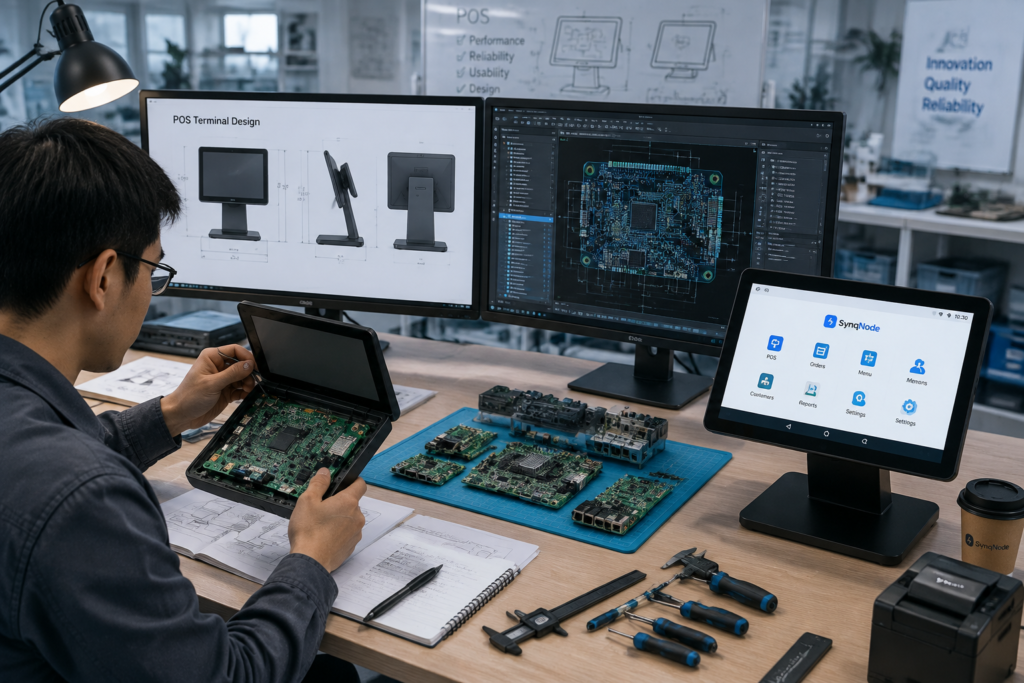
In an OEM arrangement, you — the buyer — provide the complete product design. This includes industrial design (enclosure, dimensions, materials), mechanical engineering (internal structure, mounting, thermal design), electrical engineering (PCB layout, component selection, I/O configuration), and firmware requirements. The manufacturer's role is to turn your design into a manufacturable product and produce it to your specifications.
Think of OEM as "build to print." You hand the factory a complete package — schematics, mechanical drawings, BOM (bill of materials), test specifications — and they execute production. The factory may suggest design for manufacturability (DFM) improvements, but the design decisions are yours.
2.1 What You Control in OEM
- Product appearance — Enclosure design, color, material, finish, dimensions
- Internal architecture — PCB layout, component placement, thermal management
- Hardware specifications — CPU, RAM, storage, display panel, touchscreen type
- I/O configuration — Port types, quantities, positions, cable routing
- Firmware and OS — BIOS/UEFI settings, OS image, driver stack
- Intellectual property — 100% ownership of designs, molds, and custom firmware
- Quality standards — You define test criteria, AQL levels, and acceptance thresholds
2.2 OEM Cost Structure
OEM requires significant upfront investment. Here's a realistic cost breakdown for a custom POS terminal project:
| Cost Item | Description | Typical Cost |
|---|---|---|
| Industrial design (ID) | Enclosure concept, 3D rendering, material selection | $8,000–$20,000 |
| Mechanical engineering | Structural design, DFM, assembly drawings | $10,000–$25,000 |
| PCB design and layout | Custom motherboard or carrier board design | $15,000–$40,000 |
| Injection molding tooling | Steel molds for plastic enclosure parts | $20,000–$60,000 |
| CNC tooling (metal parts) | Custom metal chassis, brackets, stands | $5,000–$15,000 |
| Prototyping (3–5 rounds) | 3D printed/CNC prototypes for fit, function, reliability testing | $8,000–$20,000 |
| Certification (CE/FCC/RoHS) | EMC, safety, environmental testing at accredited labs | $6,000–$15,000 |
| Pilot production run | 20–50 unit trial batch to validate production quality | $5,000–$12,000 |
| Total NRE (Non-Recurring Engineering) | $77,000–$207,000 | |
After NRE, the per-unit production cost for an OEM POS terminal (15-inch touchscreen, Intel processor, 4GB RAM, 128GB SSD) typically ranges from $180 to $320 depending on volume, component sourcing, and configuration. The NRE is a one-time investment — once the tooling and design exist, each subsequent order only pays for components, assembly, testing, and packaging.
3. ODM POS Manufacturing: They Design, You Customize
In an ODM arrangement, the manufacturer has already designed, engineered, and tooled a complete POS terminal platform. This platform is market-tested, certified, and in active production. Your role as a buyer is to select a platform and customize it within the manufacturer's allowed parameters — typically branding, configuration, software, and packaging.
Think of ODM as "customize a proven platform." The factory owns the base design. You choose from available options — screen size, processor, RAM, storage, OS, color, logo placement, packaging — and receive a product that's ready to sell under your brand without funding any tooling or engineering from scratch.
3.1 What You Control in ODM
- Branding — Logo silk-screen on enclosure, custom boot screen, branded packaging
- Configuration — CPU tier, RAM size, SSD capacity, touchscreen type (capacitive/resistive)
- OS and software — Windows, Android, or Linux; pre-installed software image
- Color and finish — Select from manufacturer's available colors (typically black, white, silver)
- Accessories — Customer display, MSR reader, NFC module, Wi-Fi module selection
- Regional compliance — Power adapters, keyboard layouts, language packaging
- Labels and serial numbers — Custom product labels with your brand and tracking numbers
What you do not control in ODM: enclosure shape, internal PCB layout, port positions, display panel selection, thermal design, or firmware architecture. These are locked into the manufacturer's platform design. If the platform has USB ports on the right side and you need them on the left, that's an ODM limitation that typically requires switching to OEM.
3.2 ODM Cost Structure
ODM eliminates most NRE costs. The manufacturer has already absorbed the design, tooling, and certification investment. Your costs are limited to customization and per-unit production:
| Cost Item | Description | Typical Cost |
|---|---|---|
| Logo silk-screen setup | Custom logo printing on enclosure | $200–$500 (one-time) |
| Custom boot screen | Branded BIOS/UEFI splash image | $100–$300 (one-time) |
| Custom packaging | Branded box, foam inserts, quick-start guide | $500–$1,500 (one-time) |
| Software image deployment | Factory-install your OS and application image | $300–$800 (one-time) |
| Sample units (2–3 pcs) | Evaluation units for testing and approval | $200–$600 |
| Total ODM Setup Cost | $1,300–$3,700 | |
| Per-unit production cost | Same 15" touchscreen, Intel, 4GB/128GB config | $220–$380/unit |
Notice the per-unit cost for ODM ($220–$380) is slightly higher than OEM ($180–$320) at the same configuration. This is because the ODM manufacturer builds their R&D and tooling amortization into the unit price. OEM's lower unit cost comes at the cost of a much higher upfront investment. The crossover point where OEM becomes cheaper than ODM depends on volume — we'll calculate that in Chapter 6.
4. The Full Comparison: OEM vs ODM Side by Side
Here is the complete side-by-side comparison across 12 dimensions that matter to B2B POS buyers:
| Dimension | OEM | ODM |
|---|---|---|
| Design ownership | Buyer owns 100% — designs, molds, firmware | Manufacturer owns base design; buyer owns branding |
| Customization depth | Full — enclosure, PCB, ports, thermal, firmware | Limited — logo, color, config, OS, packaging |
| Upfront NRE cost | $77,000–$207,000 | $1,300–$3,700 |
| Per-unit cost (15" POS) | $180–$320 | $220–$380 |
| Time to first sample | 3–6 months (after design completion) | 2–4 weeks |
| Time to mass production | 6–12 months | 4–8 weeks |
| MOQ (Minimum Order) | 500–1,000 units (typical) | 50–100 units (some platforms: 10–20) |
| Product differentiation | Maximum — unique product no competitor has | Moderate — same platform may be sold to competitors |
| IP protection | Full — design files, molds, firmware all yours | Shared — base IP is manufacturer's; negotiate exclusivity clauses |
| Certification | Must obtain from scratch ($6K–$15K, 4–8 weeks) | Platform already certified (CE/FCC/RoHS included) |
| R&D team required | Yes — ID, mechanical, electrical, firmware engineers | No — manufacturer handles all engineering |
| Risk level | High — design errors, certification failures, tooling rework | Low — proven platform, existing certifications, stable supply chain |
5. IP Ownership: The Hidden Complexity
Intellectual property ownership is the most overlooked dimension of the OEM vs ODM decision. Most buyers focus on cost and timeline, then discover IP issues years later when they try to switch manufacturers, file patents, or enter exclusive retail partnerships.
5.1 OEM IP Framework
In a clean OEM arrangement, the buyer owns everything:
- Industrial design files — 3D CAD models, surface models, renderings
- Mechanical drawings — Assembly drawings, tolerance specs, BOM
- Electrical designs — Schematics, PCB layout files, Gerber files
- Molds and tooling — Injection molds, CNC fixtures, test jigs (buyer-funded = buyer-owned)
- Firmware — Custom BIOS, embedded software, drivers
- Certification documents — Test reports, certificates (transferred to buyer)
This means you can switch manufacturers, file patents on your design, grant exclusivity to retail partners, and prevent the factory from selling your product to anyone else. The trade-off: you bear all the design risk and must maintain your own engineering documentation.
5.2 ODM IP Framework
In ODM, the manufacturer owns the base platform IP. You own only the customization layer — your logo, packaging design, software image, and any configuration-specific documentation. The manufacturer can (and often does) sell the same base platform to multiple buyers.
This creates three potential IP risks you must address in the contract:
| Risk | What Happens | Mitigation Clause |
|---|---|---|
| Platform sharing | Competitor buys the same ODM platform with different branding | Negotiate regional or industry exclusivity in contract |
| Software IP leakage | Your software image is accessible to factory staff who may share it | NDA + encrypted image provisioning + audit rights |
| Design feature copying | Your custom configuration or accessory design appears in manufacturer's next platform | IP assignment clause for buyer-requested modifications |
Practical advice: If you choose ODM, always negotiate exclusivity — either by region (e.g., "this platform is exclusive to us in the EU market for 24 months"), by industry (e.g., "exclusive for restaurant POS applications"), or by configuration (e.g., "our specific CPU/memory/touchscreen combination is exclusive"). Manufacturers will often grant limited exclusivity at zero or low cost because it doesn't block their other market segments.
6. The Cost Crossover: When Does OEM Become Cheaper?
OEM has higher upfront cost but lower per-unit cost. ODM has near-zero upfront cost but higher per-unit cost. At some volume, the total cost of OEM drops below ODM. That's the crossover point.
Let's calculate it with realistic numbers. Using the midpoint of our cost ranges:
| Cost Component | OEM | ODM |
|---|---|---|
| Upfront NRE | $142,000 | $2,500 |
| Per-unit cost | $250 | $300 |
| Per-unit premium (ODM over OEM) | — | +$50/unit |
| Crossover formula | NRE difference / per-unit premium = crossover volume | |
| Crossover point | ($142,000 - $2,500) / $50 = 2,790 units | |
At 2,790 units, the total cost of OEM equals the total cost of ODM. Below that volume, ODM is cheaper. Above it, OEM's lower per-unit cost recovers the NRE investment and every additional unit saves $50.
Here's the total cost at different volumes:
| Volume (units) | OEM Total Cost | ODM Total Cost | Cheaper Option |
|---|---|---|---|
| 100 | $167,000 | $32,500 | ODM (by $134,500) |
| 500 | $267,000 | $152,500 | ODM (by $114,500) |
| 1,000 | $392,000 | $302,500 | ODM (by $89,500) |
| 2,000 | $642,000 | $602,500 | ODM (by $39,500) |
| 2,790 (crossover) | $839,500 | $839,500 | Break-even |
| 5,000 | $1,392,000 | $1,502,500 | OEM (by $110,500) |
| 10,000 | $2,642,000 | $3,002,500 | OEM (by $360,500) |
The Rule of Thumb
If your projected 2-year volume is below 2,500–3,000 units, choose ODM. If it's above 5,000 units, OEM delivers significant savings. Between 2,500 and 5,000, the decision should factor in differentiation needs, IP requirements, and whether you have the engineering team to manage OEM.
7. Decision Matrix: Which Model Fits Your Buyer Profile?
The OEM vs ODM decision depends heavily on who you are. A software company, a system integrator, a distributor, and a retail chain operator all face different constraints. Here's a practical matrix for each buyer type:
| Buyer Type | Recommended Model | Why |
|---|---|---|
| ISV / Software Company | ODM (entry) → OEM (scale) | Start with ODM to validate your software on real hardware with minimal investment. Switch to OEM once volume exceeds 3,000 units/yr and you need hardware-level differentiation. |
| System Integrator | ODM (primary) | Integrators add value through software and services, not hardware design. ODM lets you brand hardware without diverting focus from integration revenue. Consider OEM only if a client demands a fully custom form factor. |
| Distributor / Wholesaler | ODM (primary) with exclusivity | Distributors need brand control and margin protection but typically lack in-house engineering. ODM with regional exclusivity clauses prevents channel conflict. OEM only viable if distributor serves a large captive market (5,000+ units/yr). |
| Retail Chain Operator | OEM (if 500+ stores) or ODM (if <200 stores) | Large chains (500+ stores × 2-4 terminals each = 1,000-2,000 units) benefit from OEM's per-unit savings and custom design for store-specific requirements. Smaller chains should use ODM to avoid NRE exposure. |
| Startup / New Brand | ODM (mandatory) | Startups must validate market demand before committing $100K+ to tooling. ODM's low entry cost ($1.3K-$3.7K) lets you launch, sell, and raise capital. Transition to OEM after proving unit economics. |
Strategic insight: The most common path is ODM-first, OEM-later. Start with ODM to validate your market, build your brand, and generate revenue. Once your annual volume crosses 2,500-3,000 units and you have a clear understanding of what hardware differentiation would unlock for your business, invest in OEM. This staged approach minimizes risk and preserves capital for growth.
8. Certification Roadmap: OEM vs ODM
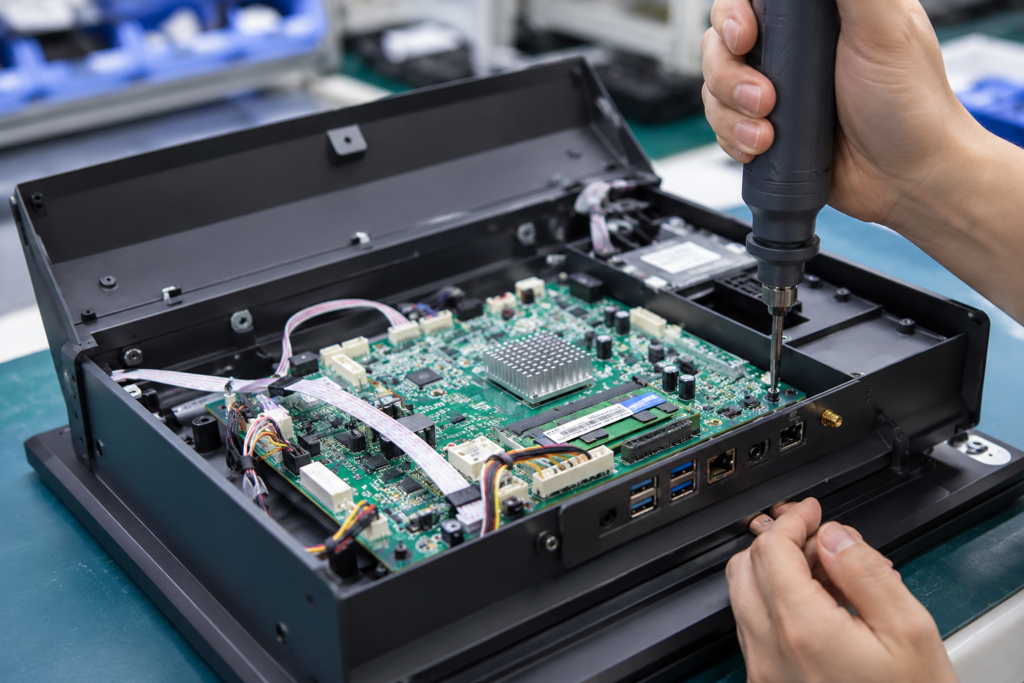
POS terminals must meet regulatory standards before they can be sold in most markets. The certification landscape is one of the biggest cost and timeline differentiators between OEM and ODM.
8.1 Required Certifications for POS Terminals
| Certification | Scope | OEM Path | ODM Path |
|---|---|---|---|
| CE | EU safety, health, environmental (EMC, LVD, RoHS) | Full testing from scratch: $2K-$5K, 3-6 weeks | Platform already certified; re-branding requires Declaration of Conformity update: $200-$500 |
| FCC | US radio frequency compliance | Full EMC + RF testing: $3K-$8K, 4-8 weeks | Already certified; FCCID transfer or new grant: $500-$1,500 |
| RoHS | Restriction of hazardous substances in electronics | Material testing per new BOM: $1K-$3K, 2-4 weeks | Already compliant; re-issue certificate with brand name: $100-$300 |
| EMV / PCI PTS | Payment security and card-present transaction security | Full hardware + security evaluation: $15K-$50K, 3-6 months | Platform may already have EMV/PCI approval; verify validity for your configuration |
| UL / ETL | US/Canada electrical safety | Full safety testing: $2K-$6K, 4-8 weeks | Typically already listed; brand update: $200-$500 |
8.2 The OEM Certification Burden
In OEM, every certification must be obtained from scratch because the product is new. A custom enclosure changes thermal characteristics (affecting EMC), a new PCB layout changes radio emissions (affecting FCC), and new components may introduce restricted substances (affecting RoHS). Even if your design uses the same display and CPU as a certified ODM platform, the certifications do not transfer — they are tied to the specific product configuration.
Total OEM certification cost: $6,000-$15,000 for basic regulatory (CE + FCC + RoHS). If you need EMV/PCI for payment certification, add $15,000-$50,000 and 3-6 months to your timeline.
8.3 The ODM Certification Advantage
ODM platforms ship with a complete certification package. The manufacturer has already invested in CE, FCC, RoHS, and often UL/ETL testing for the platform. When you customize branding, you typically only need to update the Declaration of Conformity with your company name and product model — a paperwork exercise costing $200-$1,500 total.
For EMV/PCI, some ODM platforms come pre-certified. If your configuration matches the certified spec (same MSR, same NFC module, same secure reader), the certification may transfer. If you change the payment hardware, you will need a new EMV evaluation regardless of OEM or ODM.
Important: Always ask your ODM manufacturer for the full certification document pack before placing an order. A legitimate manufacturer will provide CE/FCC test reports, RoHS compliance certificates, and safety listings. If they cannot produce these documents, the platform is not actually certified — and you will bear the cost and liability of obtaining them yourself.
9. Common Risks of Choosing the Wrong Model
Choosing OEM when you should have chosen ODM (or vice versa) creates real business consequences. Here are the most common failure scenarios we have seen across B2B POS procurement projects:
| Risk Scenario | Wrong Choice | Consequence | Cost Impact |
|---|---|---|---|
| Market shifts before launch | OEM with 9-month timeline | Competitor launches ODM product in 8 weeks, captures market. Your OEM product arrives to a saturated market. | $142K NRE + lost revenue |
| Competitor uses same ODM platform | ODM without exclusivity clause | Two brands sell the same physical terminal. Customers notice. Price war erodes margins. Brand reputation damaged. | 20-40% margin loss |
| Volume exceeds crossover but stuck on ODM | ODM at 5,000+ units/year | Paying $50/unit premium on 5,000 units = $250K/year in avoidable cost. Over 3 years, $750K lost. | $250K/year |
| Design errors in OEM prototype | OEM with inexperienced R&D team | Thermal failure in prototype round 3. Tooling rework required. Launch delayed 4 months. | $20K-$50K rework + delay |
| EMC test failure in OEM certification | OEM without pre-compliance testing | PCB redesign for EMI shielding. Re-test cycle. 8-week delay to market. | $8K-$20K + 8 weeks |
| Supplier lock-in on ODM platform | ODM with no exit clause | Manufacturer raises prices 15% after year 2. No alternative source for the same platform. Forced to re-brand a new product. | 15% cost increase + re-launch |
Risk mitigation checklist: (1) If choosing ODM, negotiate exclusivity and price-lock clauses. (2) If choosing OEM, budget 15-20% contingency on NRE for prototype rework. (3) Always conduct pre-compliance EMC testing before full certification. (4) Maintain a secondary supplier qualification even in ODM arrangements. (5) Engage a manufacturing consultant for your first OEM project — the cost ($5K-$10K) is trivial compared to a $50K tooling rework.
10. SynqNode OEM/ODM Capabilities
SynqNode operates as both an ODM platform provider and an OEM manufacturing partner. This dual capability means we can meet you wherever you are in your hardware journey — from a quick-launch branded terminal to a fully custom-designed product.
10.1 ODM Platform Portfolio
Our ODM platform lineup covers the core POS and retail hardware categories:
- All-in-one POS terminals — 15-inch and 21.5-inch capacitive touchscreen, Intel Celeron/i3/i5, fanless aluminum chassis, optional customer display
- Electronic shelf labels (ESL) — 1.54-inch to 7.5-inch e-ink displays, 2.4GHz/BLE wireless, 5-year battery life, gateway included
- Self-service kiosks — 15-inch to 32-inch touchscreen kiosks, floor-standing and wall-mount, thermal printer integrated
- Industrial Mini PCs — Fanless, VESA-mountable, Intel N5105/J4125/i7, dual LAN, wide operating temperature
- POS peripherals — Thermal receipt printers, cash drawers, customer displays, MSR/NFC readers, barcode scanners
All ODM platforms ship with CE, FCC, and RoHS certifications. Customization options include logo silk-screen, boot screen branding, custom packaging, OS image deployment, and configuration selection (CPU, RAM, storage, touchscreen type, color). MOQ starts at 50 units for most platforms.
10.2 OEM Manufacturing Services
For buyers who need full design ownership, SynqNode provides complete OEM manufacturing services:
- Industrial design — In-house ID team creates enclosure concepts, 3D renderings, and material specifications
- Mechanical engineering — DFM-optimized structural design, thermal simulation, assembly documentation
- PCB design — Custom motherboard and carrier board design with schematic capture and PCB layout
- Tooling — Injection mold design and fabrication, CNC tooling for metal components, test fixtures
- Prototyping — 3D printed and CNC-machined prototypes for fit, function, and reliability testing
- Certification support — Pre-compliance testing, lab coordination, document transfer to buyer
- Mass production — SMT lines, assembly, testing, packaging, and global logistics
In an OEM engagement, all design files, molds, tooling, and certification documents belong to you. We act as your factory — you own the product.
11. How to Start a Project with SynqNode
Whether you are ready for ODM customization or need full OEM development, the engagement process is straightforward:
| Phase | ODM Timeline | OEM Timeline | Activities |
|---|---|---|---|
| 1. Requirement briefing | 1-3 days | 3-5 days | Share your product specs, target specs, volume forecast, target markets, and branding requirements |
| 2. Platform selection / Design proposal | 2-5 days | 2-4 weeks | ODM: We recommend platforms and send spec sheets. OEM: We deliver industrial design concepts and cost estimates. |
| 3. Sample evaluation | 1-2 weeks | 8-16 weeks | ODM: Receive 2-3 branded samples for testing. OEM: Receive 3D-printed/CNC prototypes for design review. |
| 4. Pilot production | 1-2 weeks | 4-8 weeks | 20-50 unit pilot batch. Quality validation, firmware finalization, packaging approval. |
| 5. Mass production | 2-4 weeks | 4-8 weeks | Full production run. SMT assembly, integration, testing, packaging, shipping. |
| Total timeline | 4-8 weeks | 6-12 months | From first contact to mass production shipment |
Ready to discuss your POS manufacturing project?
Whether you need a branded ODM terminal in 8 weeks or a custom OEM design in 6 months, SynqNode has the engineering and production capabilities to deliver.
Contact SynqNode Solutions Team
12. Frequently Asked Questions
Q1: Can I start with ODM and later switch to OEM for the same product line?
Yes. This is the most common and recommended path. Start with an ODM platform to validate your market, build brand recognition, and generate revenue. Once your volume justifies it (typically 2,500-3,000 units/year), invest in an OEM version with custom design. You can phase the transition: keep selling the ODM product while developing the OEM replacement in parallel, then switch over when the OEM product is certified and in production.
Q2: What is the minimum order quantity (MOQ) for ODM POS terminals?
Most ODM POS terminal platforms have an MOQ of 50-100 units. Some entry-level platforms may accept 10-20 units for initial orders. The MOQ exists because the manufacturer needs to amortize the customization setup (logo printing, boot screen programming, packaging design, software image deployment) across a minimum batch. ESL and peripheral MOQs are typically lower (10-50 units).
Q3: Who owns the molds and tooling in an OEM arrangement?
In a properly structured OEM contract, the buyer owns all molds, tooling, test fixtures, and design files — because the buyer funded them. The manufacturer holds them in custody for production. If you switch manufacturers, your molds and tooling transfer with you. Always ensure your contract explicitly states buyer ownership of tooling and includes a procedure for tooling transfer if the relationship ends.
Q4: Can I get exclusivity on an ODM platform?
Yes, but it depends on the scope. Full platform exclusivity (nobody else can buy this platform) is rare and expensive — the manufacturer would need to compensate for lost sales. Regional exclusivity (exclusive in your country/region) or configuration exclusivity (your specific CPU/RAM/touchscreen combination is unique to you) is more common and often available at low or zero cost because it does not block the manufacturer from selling the same base platform in other markets or configurations.
Q5: How long does EMV/PCI certification take for a POS terminal?
EMV and PCI PTS (PIN Transaction Security) certification typically takes 3-6 months and costs $15,000-$50,000 depending on the scope (contact, contactless, PIN entry). This applies to both OEM and ODM — unless the ODM platform already has a valid EMV/PCI certification that covers your configuration. If the ODM platform is pre-certified and you use the same payment hardware, the certification transfers. If you change any payment component, you need a new evaluation.
Q6: What happens if my OEM design fails certification testing?
The most common certification failure is EMC (electromagnetic compatibility) — your custom PCB radiates too much noise. The fix typically involves adding shielding, ferrite beads, or ground plane modifications, then re-testing. Budget $8,000-$20,000 and 4-8 weeks for a rework cycle. To minimize this risk, always conduct pre-compliance testing ($2K-$5K at a local lab) before submitting for full certification. Pre-compliance testing catches 80-90% of issues at a fraction of the cost.
Q7: Can SynqNode provide both ODM and OEM for different products in my portfolio?
Absolutely. Many of our clients use ODM for their standard product line (fast time to market, low investment) while simultaneously developing an OEM product for their premium or differentiated tier. This hybrid approach lets you cover multiple market segments without over-committing capital. We manage both production lines in parallel, sharing supply chain and quality processes across both.
This article is brought to you by SynqNode Solutions Team — your B2B partner for POS terminals, electronic shelf labels, self-service kiosks, and OEM/ODM manufacturing.
Visit www.smartstoreops.com for our full product catalog and manufacturing capabilities.